The Question That Wasn't Hard

TMUA 2023 — Paper 2, Question 17
Here is the question:
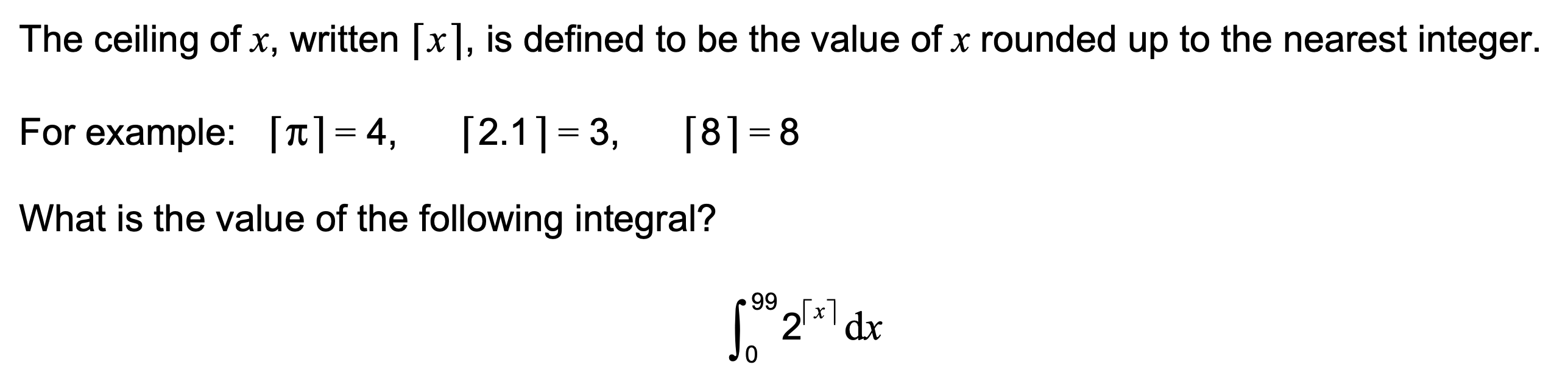
During six months of beta testing, this was one of the questions we watched most closely. It had a low solve rate — not because students lacked the mathematics, but because of what happened in the first few seconds. You could see it in the data: students who spent time at the start working through the definition got it. Students who didn't, almost never recovered.
Most students who see this for the first time feel a specific kind of unease. There's a function they've probably never encountered — the ceiling function — sitting inside an exponential, sitting inside an integral. It looks like it belongs in a university analysis course, not an admissions test.
That feeling is the trap. And the question is designed to produce it.
What the Ceiling Function Actually Does
Before reaching for any technique, read what the question tells you.
The key observation is this: on any interval , the ceiling function is constant. It always equals .
So on , we have . On , we have . And so on, all the way to , where .
Once you see that, the integral stops being an integral.
Breaking It Apart
So we can split the integral:
Each piece is a rectangle of height and width :
The integral has become a sum. The calculus is gone. What remains is a geometric series.
The Geometric Series
Using the standard formula with , :
The answer is F.
Where Students Go Wrong
The wrong answers are not random. They're there for a reason.
This isn't even one of the options — which tells you something. When your answer doesn't appear in a multiple choice list, the error is usually structural, not computational. You didn't make an arithmetic slip. You used the wrong approach entirely.
The other cluster of errors comes from the geometric series. Options A through E are all plausible if you make an off-by-one mistake or misapply the formula:
A) : Took only the last term
B) : Summed from instead of
C) : Wrong exponent in the formula
D) : Forgot to subtract 2
E) : Off-by-one in the series bounds
F)
Getting to the right method and then losing marks in the algebra is exactly as costly as never finding the method at all. Both leave you with a wrong answer.
The Real Lesson
This question is not testing whether you know the ceiling function. It tells you what the ceiling function is. It is not testing integration technique. The integral disappears the moment you understand the function.
What it is testing is whether you slow down long enough to read what's in front of you.
The ceiling function looks exotic. The notation looks unfamiliar. Combined with an integral and an exponential, the whole expression signals difficulty before you've processed a single word of the question. A lot of students respond to that signal by skipping to the options, trying to work backwards, or reaching for calculus tools that don't apply here.
The students who get this right are the ones who pause, read the definition, work through the examples the question gives them, and notice that the function is piecewise constant. Everything after that is straightforward.
That's not a mathematical insight. It's a discipline. And it's the thing Paper 2 keeps testing, in question after question, in different clothes each time.