A Problem From My Engineering Interview

Last winter, I had my interview online, sitting at a blank white meeting room that I rented in a study cafe in Korea. I can't share the exact question due to NDA, but I can share a problem from Seoul National University general physics course that covers the same ground, and more importantly, the same conceptual leaps that I wasn't prepared for the first time.
Here is the problem.
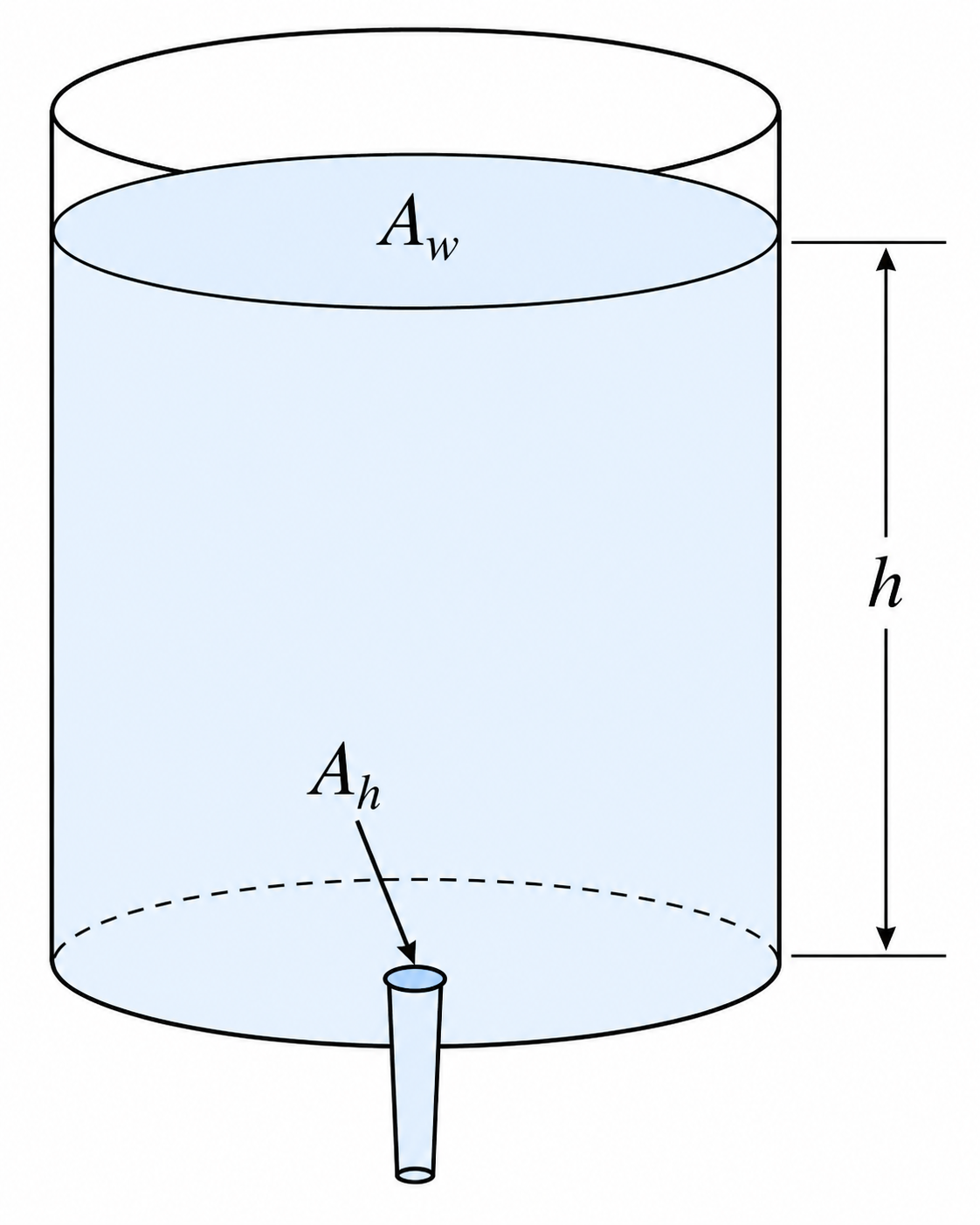
The tank is full at (i.e. ). Find the time for the tank to completely empty.
Starting Point
When you see a problem like this cold, the instinct is to reach for Bernoulli's equation immediately. That instinct is right, but incomplete. Before Bernoulli is useful, you need a relationship between the velocity of the draining water and the rate at which the water level drops.
That relationship comes from the continuity equation, the first thing you learn in fluid mechanics, and the thing that most IB and A-Level students haven't encountered.
Step 1: Continuity
The continuity equation is just conservation of mass applied to fluid flow. For an incompressible fluid, the mass passing through any cross-section of a pipe per unit time must be the same. So if u is the speed at which the water surface is falling and v is the speed of water exiting the hole:
Since :
The density cancels. Each is the speed at that cross-section multiplied by an arbitrary time interval :
Intuitively: the narrower the hole relative to the tank, the faster the water must exit to conserve mass. The tank surface drops slowly; the exit jet moves quickly.
Step 2: Bernoulli's Equation
With continuity established, Bernoulli's equation connects pressure, velocity, and height between two points in the flow. It is, at its core, an energy conservation statement:
We apply this between the water surface (point 1) and the exit hole (point 2). Both are exposed to atmospheric pressure , so the pressure terms cancel. Taking the hole as the height reference () and letting be the current water depth:
Substituting from the continuity equation:
Solving for :
Step 3: Setting Up the Differential Equation
Now recall what u actually represents: the speed at which the water level is falling. Since h decreases over time:
The negative sign is there because h is measured upward from the base, but the surface is moving downward. Substituting:
Grouping the constants:
Step 4: Solving by Separation of Variables
Separating and integrating from t = 0 to t = T, and from h = H to h = 0:
Why This Question Is Hard
This is a problem that a strong IB or A-Level student has the tools to solve barely. Bernoulli's equation, in a simplified form, does appear on the syllabus. Variable separation is a calculus technique that's taught, at least in principle.
But the continuity equation is university-level fluid mechanics. You don't encounter it in school, and without it the problem has no entry point. Even with a hint, arriving at that idea under interview pressure, in a timed setting, in front of two Cambridge academics, is a different thing entirely from recognising it on a page.
And the variable separation, while technically straightforward, requires you to keep track of signs carefully and set up the integration limits correctly. In December of exam year, a lot of students haven't yet covered this in their maths course.
The Follow-Up
Good interview questions don't end. They extend. The natural follow-up to this problem is:
Think about what changes physically when the tank is sealed. It requires knowledge from a seemingly unrelated topic.
What This Taught Me
When I sat my first Cambridge interview, I wasn't ready for this kind of problem. The gap wasn't in calculus or in physics intuition. It was in the vocabulary, the concepts that university-level physics introduces as foundational, and that school physics never gets to.
After my first application, I spent time studying general physics properly. Not IB extended material. Not A-Level further content. University-level mechanics and fluid dynamics, the kind that introduces continuity and works through problems like this one from first principles. When a similar problem came up in my second interview, I had the language to approach it.
That's the argument for going beyond the syllabus. Not to show off. Not to memorise university content. But because the interview is testing whether your thinking can move into unfamiliar territory and still find a route through. The students who can do that aren't necessarily the most talented. They're the ones who prepared at the right level.